
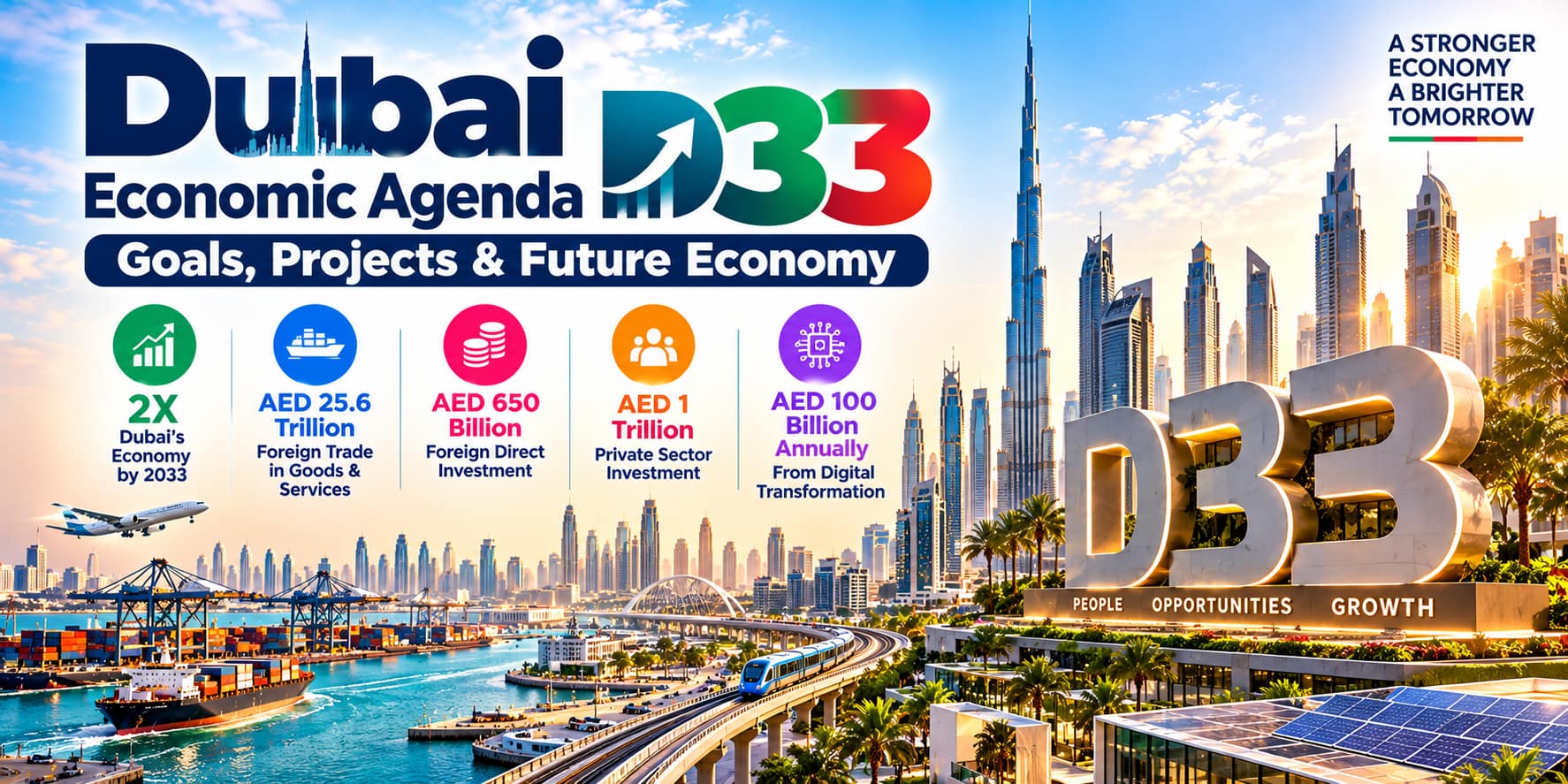
Dubai Economic Agenda D33 is a long-term economic roadmap designed to double the size of Dubai’s economy by 2033 and strengthen its position among the world’s leading economic cities. Launched in January 2023, the agenda outlines a series of economic targets, transformational projects and development priorities intended to support business growth, international trade, investment, innovation and productivity.
For businesses, investors and professionals following Dubai’s economic development, D33 provides a framework for understanding the emirate’s future priorities. It identifies areas where government initiatives, infrastructure development, digital transformation and private-sector participation are expected to contribute to economic growth over the coming decade.
What Is Dubai Economic Agenda D33?
Dubai Economic Agenda D33 is an economic strategy introduced by Dubai’s leadership on 4 January 2023. The letter and number in its name refer to Dubai’s development agenda leading towards 2033.
The strategy includes 100 transformational projects and a collection of economic targets covering trade, investment, private-sector activity, domestic demand and digital transformation.
Rather than focusing on a single industry, D33 addresses the broader economic system. Its objectives include strengthening Dubai’s international competitiveness, improving productivity, expanding commercial relationships and encouraging innovation across established and emerging sectors.
Foreign Investment in Dubai: FDI, Investors & Global Companies
The agenda also seeks to build on Dubai’s existing strengths while developing new sources of economic value. This includes supporting international business activity, expanding opportunities for local companies and creating conditions for businesses to grow beyond their initial markets.
D33 is part of Dubai’s wider long-term planning framework and should be understood as a set of objectives and initiatives, not as a guarantee that every target will automatically be achieved.
Dubai Economic Agenda D33: Key Goals for 2033
The agenda sets out measurable ambitions that help explain the scale of Dubai’s planned economic transformation.
The following figures are official targets announced for the ten-year period associated with D33. They are targets, not statements that the amounts have already been achieved.
Dubai Professional Services & Knowledge Economy: Key Sectors, Expertise & Economic Growth
Double the Size of Dubai’s Economy
One of the central goals of D33 is to double the size of Dubai’s economy by 2033.
Achieving this ambition requires growth across multiple economic activities, including trade, services, investment, technology, tourism and other productive sectors.
The objective is not simply to increase the number of businesses operating in Dubai. It also involves expanding economic output, improving productivity and strengthening the emirate’s ability to attract commercial activity from international markets.
Dubai Entrepreneurship & Startup Ecosystem: Key Hubs, Accelerators & Founder Support
Increase Foreign Trade to AED 25.6 Trillion
D33 aims to increase the total value of foreign trade in goods and services to AED 25.6 trillion over the ten-year period.
The agenda also seeks to add 400 cities to Dubai’s foreign trade network as key trading partners.
These targets reflect the importance of international commercial relationships to Dubai’s economic model. Expanding trade connections can create opportunities for exporters, importers, logistics providers, manufacturers and companies supplying services to international customers.
The trade target refers to cumulative activity over the specified decade, not AED 25.6 trillion in trade every year.
Attract AED 650 Billion in Foreign Direct Investment
D33 aims to attract AED 650 billion in foreign direct investment over the ten-year period.
The objective is to strengthen Dubai’s appeal to international companies and investors while encouraging investment that contributes to productive economic activity.
Foreign direct investment may support new projects, business expansion, technology operations, industrial facilities and other long-term commercial activities.
For businesses monitoring the agenda, the important question is not only how much investment is announced, but also which sectors receive it, how projects progress and what economic activity they generate.
Increase Private-Sector Investment to AED 1 Trillion
The agenda targets AED 1 trillion in private-sector investment over the decade.
Private investment can contribute to business expansion, infrastructure-related activity, technology development, commercial facilities and other projects that support economic growth.
This target highlights the role of companies and investors alongside government initiatives. Sustained private-sector participation is important because businesses make decisions based on customer demand, operating costs, expected returns and long-term commercial prospects.
Generate AED 100 Billion Annually Through Digital Transformation
D33 aims to generate new economic value from digital transformation at an average of AED 100 billion annually.
Digital transformation involves more than introducing new software. It can include redesigning business processes, automating operations, improving data use, developing digital services and adopting technologies that increase productivity.
The target reflects the intended economic contribution of digital transformation projects. It should not be interpreted as a direct funding allocation or as revenue guaranteed to individual technology companies.
Other Major Economic Targets
The agenda also identifies additional targets for the decade:
- Government expenditure: AED 700 billion.
- Domestic demand for goods and services: AED 3 trillion.
- Private-sector investment: AED 1 trillion.
- Foreign direct investment: AED 650 billion.
- Foreign trade in goods and services: AED 25.6 trillion.
These figures cover different economic measures and should not be added together as though they represent a single pool of money. Each target has its own definition and measurement basis.
Major Dubai Economic Agenda D33 Projects
D33 includes a programme of 100 transformational projects. The first announced package introduced initiatives addressing trade, industrial development, business growth, innovation and employment.
Understanding these projects provides a more practical view of how the agenda is intended to support economic change.
Dubai Economic Corridors 2033
Dubai Economic Corridors 2033 is designed to strengthen commercial connections with markets in Africa, Latin America and Southeast Asia.
The initiative reflects Dubai’s role in connecting international suppliers, manufacturers, service providers and customers.
Stronger commercial corridors can create opportunities for businesses involved in trade, distribution, logistics and cross-border services. However, individual companies still need to evaluate market demand, commercial partners and the requirements of each destination market.
Dubai Traders Programme
The Dubai Traders initiative aims to empower a new generation of traders in key sectors.
Its broader purpose is to support trading businesses and strengthen Dubai’s commercial ecosystem. The initiative is particularly relevant to entrepreneurs and businesses interested in developing trading activities and expanding their commercial capabilities.
For readers, it illustrates how D33 combines large economic targets with initiatives designed to support businesses participating in Dubai’s trading economy.
Dubai Unified Licence
The Dubai Unified Licence initiative introduces a unique commercial identity for companies across Dubai’s economic zones.
The initiative is intended to improve business identification and support a more connected commercial environment.
Its relevance extends to companies operating across different parts of Dubai’s business landscape. However, a unified commercial identity should not be confused with a replacement for every licence, approval or regulatory obligation that applies to a business.
Sandbox Dubai
Sandbox Dubai was announced as an initiative to support the testing and commercialisation of new technologies.
The concept is important because emerging technologies may require controlled environments in which businesses and relevant stakeholders can examine practical applications before wider adoption.
For innovative companies, this type of initiative can help connect experimentation with commercial development. Participation conditions and the regulatory treatment of a particular technology depend on the relevant programme and sector.
SME Scale-Up Programme
D33 includes a programme intended to identify and support 400 high-potential small and medium-sized enterprises.
The objective is to help selected companies strengthen their capabilities and pursue growth, including expansion into international markets.
This initiative differs from general business setup support. Its emphasis is on helping promising existing businesses develop their capacity and scale their operations.
The selection criteria, current programme availability and benefits should be verified before a business assumes it qualifies.
Global Unicorn Scale-Up Programme
The initial D33 project package also included a programme designed to support 30 companies in new economic sectors as they pursue global unicorn status.
A unicorn generally refers to a privately held startup valued at USD 1 billion or more.
The initiative reflects an ambition to develop companies with the potential to achieve substantial international scale. It does not mean that every participating company is already a unicorn or that the target outcome is guaranteed.
Green and Sustainable Manufacturing
D33 includes plans to strengthen manufacturing through green and sustainable approaches.
This priority connects industrial development with resource efficiency, advanced production and sustainability.
Businesses involved in industrial technology, production systems, equipment and related services may find this area relevant when assessing Dubai’s longer-term economic priorities.
The commercial value of any specific opportunity depends on project requirements, market demand, investment conditions and applicable environmental standards.
D33 and Dubai’s Future Economic Sectors
D33 does not restrict Dubai’s economic development to a fixed list of industries. Instead, it sets objectives that can influence activity across several sectors.
Digital Economy and Advanced Technology
Digital transformation is a central element of the agenda. Businesses can contribute through technology adoption, digital services, automation and products that improve commercial productivity.
The economic impact depends on whether these technologies deliver measurable improvements, create useful services or support new sources of revenue.
Trade, Logistics and International Connectivity
The agenda’s trade ambitions and economic corridor initiatives reinforce the importance of Dubai’s connections with global markets.
Trade-related businesses may benefit from stronger commercial relationships, while logistics and distribution companies can evaluate opportunities associated with changing trade patterns.
The scale of any opportunity will depend on actual trade flows, customer requirements and the competitiveness of individual businesses.
Advanced Manufacturing
Manufacturing development is another area associated with D33’s long-term priorities.
The focus on industrial value addition, export growth and sustainable manufacturing can support interest in more productive and technologically advanced industrial activities.
Companies assessing this area should consider infrastructure requirements, supply-chain access, production costs and the market for their products.
Finance and Business Services
Dubai’s ambitions for international competitiveness and investment attraction also support the wider importance of finance and professional services.
Businesses in these fields may participate by serving international companies, supporting investment activity or developing specialised commercial services.
Sector-specific requirements continue to apply, particularly where financial activities are regulated.
Tourism and Business Activity
D33 seeks to reinforce Dubai’s position as an international destination for tourism and business.
Tourism and business travel contribute to demand for accommodation, transport, events, hospitality and related services.
However, D33 is an economic agenda rather than a detailed tourism plan. Specific tourism targets and visitor-related initiatives should be examined separately when evaluating that sector.
How D33 Could Affect Businesses and Investors
The value of understanding D33 lies in identifying how its objectives may relate to real commercial decisions.
For an established company, the agenda can provide context for evaluating Dubai’s long-term economic priorities. For investors, it can help identify sectors and policy initiatives worth monitoring. For smaller businesses, specific programmes may offer relevant opportunities if the business meets their requirements.
Three considerations are especially important.
First, distinguish strategic priorities from confirmed commercial opportunities. A sector’s presence in an economic strategy does not guarantee customer demand or profitability for every business operating in that sector.
Second, look for specific initiatives. A named programme with published eligibility conditions and an application process is more actionable than a broad economic ambition.
Third, monitor implementation. Announcements, project launches, funding commitments and completed outcomes represent different stages of progress. Understanding these differences helps readers assess the practical significance of new developments.
Businesses should use D33 as one source of strategic context alongside market research, financial analysis and sector-specific information.
How to Track Dubai Economic Agenda D33 Progress
Following the agenda’s progress requires more than reading announcements about new projects. Readers should compare targets with published implementation information and clearly defined economic indicators.
Follow Official Economic Updates
Dubai’s government entities publish information about strategic initiatives, project launches and economic developments.
These updates help readers understand which programmes have advanced, which new measures have been announced and how individual initiatives relate to the wider agenda.
Review Trade and Investment Indicators
Trade values and foreign direct investment figures can help show how Dubai’s international economic relationships are developing.
When comparing figures, readers should confirm whether they represent annual results, cumulative totals, announced projects, estimated investment or completed activity.
Monitor Business and Digital Transformation Initiatives
Updates on SME programmes, innovation initiatives and digital transformation can reveal how the agenda is being translated into business-facing projects.
Eligibility, programme participation and measurable results are more informative than simply counting announcements.
Compare Results with the Original Targets
D33 was introduced with a defined set of objectives for the decade leading to 2033.
Progress should therefore be assessed against the original targets and the relevant reporting periods. A change in one indicator does not necessarily mean that every other objective is progressing at the same pace.
A balanced assessment should consider the overall economic context, the performance of different sectors and the status of individual projects.
Challenges in Achieving the D33 Economic Goals
Large economic programmes operate within a changing global environment. Dubai’s ability to achieve its ambitions will depend on a combination of local implementation, business performance and external conditions.
Global Economic Conditions
International trade, capital flows and business investment can be affected by global economic growth, interest rates, geopolitical developments and changes in consumer demand.
These factors can influence the pace of investment and the performance of companies operating in Dubai.
Productivity and Skills
Economic expansion requires businesses to improve productivity and access appropriate skills.
Technology adoption, professional development and effective business management can help companies compete, but the benefits vary according to how successfully organisations implement change.
Competition Between Global Business Centres
Dubai competes with other international cities for companies, investors, talent and major projects.
Maintaining competitiveness requires continued attention to infrastructure, business services, innovation, operating efficiency and the wider business environment.
Turning Announcements into Measurable Outcomes
A strategic target becomes meaningful when projects are implemented and generate measurable economic value.
The status of each initiative matters because an announcement, a programme launch and a completed project do not represent the same level of progress.
For readers evaluating D33, this is one of the most important distinctions when interpreting official updates.
Dubai Economic Agenda D33 and the Future Economy
D33 sets out an ambition for a larger, more productive and internationally connected Dubai economy by 2033.
Its focus on trade, foreign investment, private-sector activity, digital transformation and industrial development provides a framework for understanding the emirate’s longer-term economic direction.
The agenda’s success will depend on how effectively its initiatives are implemented, how businesses respond to changing conditions and how much measurable economic value is created.
For companies and investors, the most useful approach is to follow individual projects, understand the indicators behind the targets and assess opportunities on their commercial merits.
Conclusion
Dubai Economic Agenda D33 is a major economic roadmap built around doubling the size of Dubai’s economy by 2033 and strengthening its position among leading global economic cities. Its targets cover international trade, foreign direct investment, private-sector investment, digital transformation and domestic demand.
Projects such as Dubai Economic Corridors 2033, Dubai Traders, Sandbox Dubai and programmes supporting high-potential companies illustrate how the agenda seeks to connect strategic ambitions with business activity.
For readers following Dubai’s future economy, D33 provides a useful framework for understanding policy priorities and tracking economic developments. The clearest picture will come from comparing official targets with verified progress, distinguishing announcements from completed outcomes and assessing how individual initiatives contribute to Dubai’s wider economic transformation.






Dubai Entrepreneurship & Startup Ecosystem Guide
[…] Dubai Economic Agenda D33: Goals, Projects & Future Economy […]