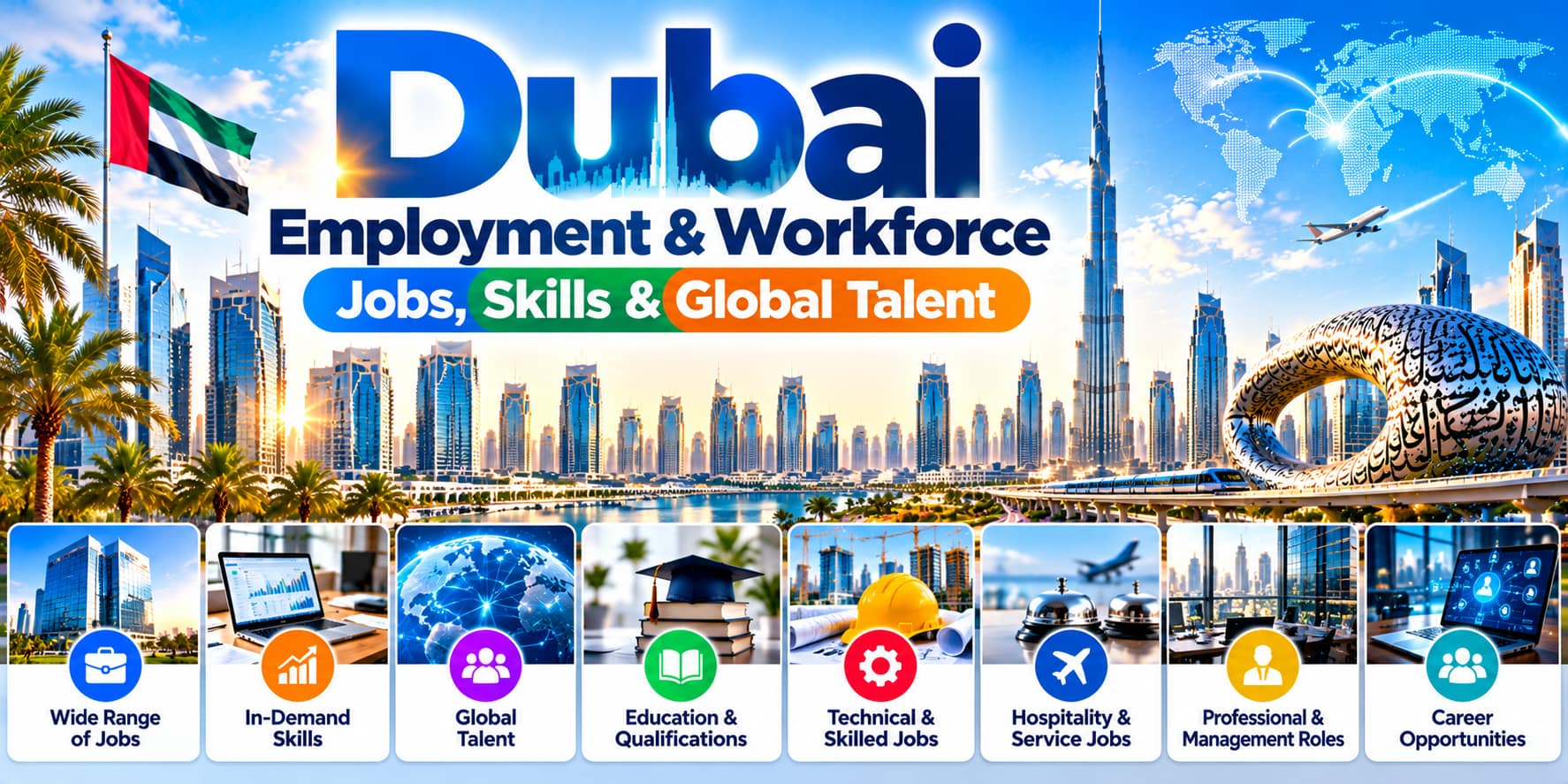
Dubai Employment & Workforce covers the wide range of jobs, professional skills and international talent that support the emirate’s economy. From engineers, healthcare professionals and financial specialists to hospitality employees, technicians, sales workers and skilled tradespeople, Dubai’s workforce serves businesses across many industries.
Dubai attracts professionals from different countries because employers need a combination of technical expertise, practical experience, industry qualifications and workplace skills. At the same time, the employment market includes opportunities at different career stages, from entry-level positions to specialist and senior management roles.
Understanding Dubai’s employment market helps job seekers identify relevant career paths, recognise the skills employers value and understand how international professionals contribute to the city’s workforce.
1. Major Types of Jobs in Dubai
Dubai’s employment market includes professional, technical, administrative, service-related and operational occupations. The responsibilities and entry requirements differ according to the employer, industry and level of the position.
Professional and Specialist Jobs
Professional roles generally require specialised knowledge, relevant education or substantial industry experience. Examples include accountants, engineers, architects, doctors, teachers, legal professionals, business analysts and project managers.
Some professions also require recognition of qualifications, registration or a licence from the relevant authority before an individual can practise.
Dubai Finance & Financial Services: DIFC, Banking & Investment
Dubai Technology & Innovation Economy: AI, ICT & Startups
Technical and Skilled Jobs
Technical and skilled occupations involve practical expertise, equipment operation, maintenance, technical support or specialised trade skills.
Examples include electrical technicians, mechanical technicians, HVAC technicians, electricians, maintenance specialists, equipment operators and construction tradespeople. Certain roles require vocational training, safety certifications or occupational licences.
Administrative and Office Jobs
Administrative employees help organisations manage daily operations. Positions may include office administrators, receptionists, document controllers, data-entry staff, executive assistants, customer-service representatives and administrative coordinators.
Employers commonly value organisational ability, accurate record-keeping, communication, computer literacy and the ability to manage multiple tasks.
Sales, Retail and Customer-Service Jobs
Dubai’s commercial environment creates demand for sales executives, retail assistants, customer-service agents, account representatives, merchandising staff and business development professionals.
The required skills depend on the role but often include product knowledge, communication, customer relationship management, negotiation and problem-solving.
Dubai Retail & Wholesale Trade: A Major Economic Sector
Dubai’s Manufacturing Industry: Industrial Growth & Future Production
Hospitality, Tourism and Service Jobs
Hotels, restaurants, tourism businesses and related service providers employ professionals such as chefs, hotel managers, front-office staff, food-service employees, housekeeping personnel, travel consultants and guest-relations specialists.
Relevant experience, customer service, communication and operational standards can be important selection criteria.
Logistics, Transport and Operational Jobs
Transport and logistics operations require drivers, warehouse associates, inventory controllers, delivery personnel, logistics coordinators, equipment operators and supply-chain specialists.
Some roles require specific driving licences, equipment certifications, physical capability or experience with inventory and operational systems.
These examples illustrate the variety of employment available in Dubai. They do not guarantee that vacancies are available at any particular time.
2. Entry-Level, Experienced and Specialist Roles
The experience required for a job can be as important as its job title. Understanding the difference between career levels helps candidates target positions that match their qualifications and work history.
Entry-Level Jobs
Entry-level roles are generally designed for candidates with limited professional experience. Examples may include junior administrative assistants, retail associates, customer-service representatives, hospitality staff and trainee positions.
Depending on the employer, candidates may be assessed on their education, communication, reliability, basic digital skills and willingness to learn.
Entry-level does not necessarily mean that no qualifications are required. Certain occupations have mandatory training, licensing or minimum education requirements.
Experienced Professional Jobs
Experienced positions generally require relevant employment history and the ability to work with less supervision. Examples include experienced accountants, engineers, sales executives, HR specialists, technicians and operations coordinators.
Employers may assess practical achievements, industry knowledge, project experience and the candidate’s ability to manage responsibilities independently.
Specialist and Senior Management Roles
Specialist positions require advanced knowledge in a defined area, while senior management roles usually involve leadership, planning, decision-making and responsibility for teams or business outcomes.
Examples include senior engineers, cybersecurity specialists, clinical specialists, compliance professionals, department heads and operations directors.
The experience and qualifications required vary considerably. Candidates should compare the actual job description with their background rather than relying on the title alone.
3. Skills Employers Look for in Dubai
Employers assess a combination of technical skills, professional knowledge and personal capabilities. The relative importance of each depends on the job.
Technical and Job-Specific Skills
Technical skills are the abilities needed to perform the duties of a particular occupation. They may include engineering knowledge, accounting procedures, medical expertise, equipment maintenance, software proficiency or inventory management.
Candidates should identify the practical skills listed in a vacancy and demonstrate them through relevant experience, qualifications or work samples where appropriate.
Communication and English Proficiency
English is widely used in many international business environments in Dubai, although language requirements vary by employer, industry and role. Arabic and other languages can also be valuable for positions involving particular customers, markets or public-facing responsibilities.
Clear communication helps employees understand instructions, coordinate with colleagues, explain information and deal with customers professionally.
Digital and Computer Skills
Basic digital literacy is useful across many occupations. Depending on the role, employers may require spreadsheet skills, business software knowledge, digital record management, scheduling tools or specialised industry systems.
Advanced digital capabilities are more relevant to selected technical positions. Candidates should develop skills that directly match their target occupation instead of assuming that every job requires advanced AI or programming knowledge.
Problem-Solving and Adaptability
Employees may need to respond to changing customer requirements, operational issues, deadlines or unexpected problems. Employers often value the ability to assess situations, identify practical solutions and learn new procedures.
Adaptability is especially useful in workplaces involving diverse teams, evolving technologies or changing business priorities.
Teamwork and Professional Conduct
Teamwork, punctuality, accountability, reliability and respect for workplace procedures support effective operations.
For supervisory positions, additional skills may include delegation, performance management, conflict resolution and decision-making.
4. Education, Qualifications and Professional Licensing
Education and professional qualifications can influence eligibility for employment in Dubai. Requirements depend on the occupation, employer and applicable regulations.
Academic Qualifications
Some positions require a bachelor’s degree or postgraduate qualification, while others accept diplomas, vocational certificates, school qualifications or relevant practical experience.
For certain employment procedures, foreign-issued academic certificates may need attestation or additional recognition. Candidates should confirm the requirements that apply to their specific role and circumstances.
Vocational Training and Certifications
Vocational qualifications can be important for technical and practical occupations. Depending on the job, relevant training may cover electrical work, mechanical maintenance, workplace safety, equipment operation, hospitality or other specialised activities.
A certificate can demonstrate training, but it does not automatically replace a mandatory professional licence or practical experience.
Regulated Professions
Some occupations require approval, registration or licensing from a competent authority. Healthcare professionals, teachers and certain other regulated practitioners may need to satisfy profession-specific requirements before working in their roles.
Applicants should verify eligibility and recognition procedures before accepting a position or making relocation plans.
Matching Qualifications to the Job
A useful approach is to compare the vacancy’s stated education, experience, technical skills and licensing requirements with the candidate’s actual profile.
Where requirements are unclear, candidates should seek clarification from the employer or relevant authority rather than assuming that a qualification accepted in one country will automatically be accepted in the UAE.
5. Global Talent and Dubai’s International Workforce
Dubai’s workforce includes UAE nationals and expatriates from many countries. International professionals contribute skills, experience, language capabilities and industry knowledge across different occupations.
The UAE has also developed a national strategy to attract and retain global talent, particularly in specialised fields that support its economic and knowledge-development objectives.
Why Employers Recruit International Professionals
Employers may recruit internationally when they need particular technical expertise, professional qualifications, language skills or experience that matches their business requirements.
International recruitment can also help organisations serve customers across multiple markets and work with teams that understand different business environments.
The need for overseas talent varies by occupation, employer and economic conditions. It should not be assumed that every sector faces the same skills shortage.
Working in Multicultural Teams
International workplaces bring together employees with different educational backgrounds, languages and professional experiences.
Successful collaboration requires clear communication, mutual respect, effective teamwork and an understanding of workplace expectations.
Employees may also need to adapt to different approaches to meetings, feedback, customer service and decision-making.
Professional Mobility and Career Development
International professionals may move to Dubai to pursue a new role, develop specialist experience or progress into positions with regional or international responsibilities.
Career outcomes depend on qualifications, experience, employer requirements, market conditions and individual performance. Relocation alone does not guarantee higher pay or faster career progression.
6. Why International Professionals Consider Dubai
Dubai attracts international workers for several reasons, although the advantages differ according to personal circumstances and the role being considered.
Access to international employers: Professionals may find opportunities with regional businesses, multinational companies and organisations serving several markets.
Industry diversity: Employment spans areas such as healthcare, education, construction, hospitality, logistics, retail, finance and technology.
Multicultural working environments: Employees can gain experience working with colleagues and customers from different countries.
Regional career opportunities: Some positions provide exposure to projects and markets across the Middle East, Africa and South Asia.
Professional development: Employees may gain new technical knowledge, industry experience and management responsibilities through suitable roles.
Candidates should also evaluate living expenses, accommodation, transport, working hours, employment benefits, contract conditions and family requirements. A job offer should be assessed using its complete financial and professional terms rather than salary alone.
7. Work Permits and Employment Eligibility
Foreign nationals generally need the appropriate legal authorisation to work in Dubai. The specific process depends on the person’s circumstances, the employer and the applicable employment or immigration framework.
For many private-sector employees, the process involves a formal job offer, an employment contract and the relevant work permit and residence procedures.
Employer-Sponsored Employment
In many standard employment arrangements, the employer initiates the necessary work authorisation procedures. Additional requirements may include identity documents, medical fitness procedures, Emirates ID processing and the attestation or approval of qualifications where applicable.
Candidates should confirm the current requirements with the relevant authorities and employer before travelling or starting work.
Qualifications and Eligibility
The job title, professional qualifications, experience and any mandatory licence can affect eligibility for a position. Regulated occupations may have additional requirements beyond the general employment process.
Candidates should ensure that the job offer, employer details and employment conditions are genuine and consistent with the applicable rules.
Verifying a Job Offer
Before accepting employment, candidates should review the job title, salary, benefits, working hours, probation terms and other contractual conditions.
They should also be cautious about recruitment fraud. Requests to pay unauthorised recruitment fees, promises of guaranteed employment without proper documentation or pressure to transfer money to unknown parties should be treated carefully.
This section provides a general overview rather than a complete visa or company-setup guide.
8. Employer Expectations and Workplace Skills
Beyond formal qualifications, employers consider whether candidates can perform reliably and work effectively within an organisation.
Relevant Experience
Candidates should explain how their previous work relates to the advertised role. Specific examples of completed projects, responsibilities and measurable achievements can help employers understand their capabilities.
CV and Interview Preparation
A well-organised CV should clearly identify relevant experience, education, certifications and job-specific skills. It should be accurate and tailored to the position.
During interviews, candidates may be asked to explain their work history, solve practical problems or demonstrate technical knowledge. Some occupations also involve assessments, portfolio reviews or practical tests.
Reliability and Professional Standards
Employers may assess attendance, time management, attention to detail, confidentiality and compliance with workplace procedures.
For positions involving customers or sensitive information, professionalism and appropriate handling of information can be particularly important.
Continuous Learning
Employees may need to update their skills as tools, industry practices and business requirements change. Relevant training can improve performance and help professionals prepare for new responsibilities.
The most useful learning priorities are those connected to the employee’s occupation and realistic career goals.
9. Workforce Challenges in Dubai
Dubai’s employment market offers a variety of career paths, but candidates and employers also face challenges.
Competition for Positions
Popular roles may attract applicants with similar qualifications and experience. Candidates can improve their preparation by targeting suitable vacancies and demonstrating relevant achievements rather than sending identical applications to every employer.
Skills Gaps
Employers may struggle to find candidates who combine the required technical knowledge, practical experience and communication skills.
Training, industry experience and clearer alignment between education and job requirements can help address some of these gaps.
Cost of Living and Employment Benefits
Candidates need to compare compensation with the cost of accommodation, transport, insurance and other expenses. Benefits and working conditions vary between employers and contracts.
A salary figure alone does not provide a complete picture of a job’s financial value.
Retaining Skilled Employees
Employers may need to provide appropriate career progression, competitive compensation, effective management and opportunities for development to retain experienced workers.
Employee retention also depends on workplace culture, job satisfaction and individual circumstances.
10. Future Jobs and Skills in Dubai
Dubai’s future workforce will continue to depend on the needs of its industries, technological changes and broader economic conditions. Certain capabilities may become more important as businesses modernise their operations, but demand will vary by occupation.
Digital and Data Skills
Digital literacy, data interpretation and the ability to work with business software can benefit employees across many fields. Advanced data, AI and cybersecurity skills are more directly relevant to specialist roles.
Technical and Engineering Skills
Construction, infrastructure, industrial operations and equipment-intensive businesses require people with relevant technical knowledge and practical experience.
The specific qualifications and demand depend on project activity, employer requirements and industry conditions.
Healthcare and Education Skills
Healthcare providers require qualified clinical and support professionals, while education institutions need appropriately qualified teachers and specialists.
These professions may involve formal registration, licensing or recognition requirements.
Management and People Skills
Leadership, communication, coordination and problem-solving remain relevant as employees progress into supervisory and management positions.
The ability to work across teams and manage responsibilities effectively can complement technical expertise.
Lifelong Learning
Employees who regularly review job requirements and update relevant skills may be better prepared for changing workplace needs.
However, no single skill guarantees employment. Career decisions should reflect actual vacancies, the candidate’s background and the requirements of the intended occupation.
Conclusion
Dubai Employment & Workforce brings together a diverse range of jobs, professional skills and international talent. The employment market includes entry-level positions, skilled trades, administrative work, specialist professions and senior management roles, each with different requirements.
For job seekers, the most practical approach is to identify suitable occupations, understand the required qualifications and skills, and prepare evidence of relevant experience. International professionals must also confirm applicable employment authorisation and profession-specific requirements.
Dubai’s workforce will continue to evolve alongside its industries and business needs. Matching the right skills to the right opportunities remains important for employees seeking career development and employers building capable, diverse teams.