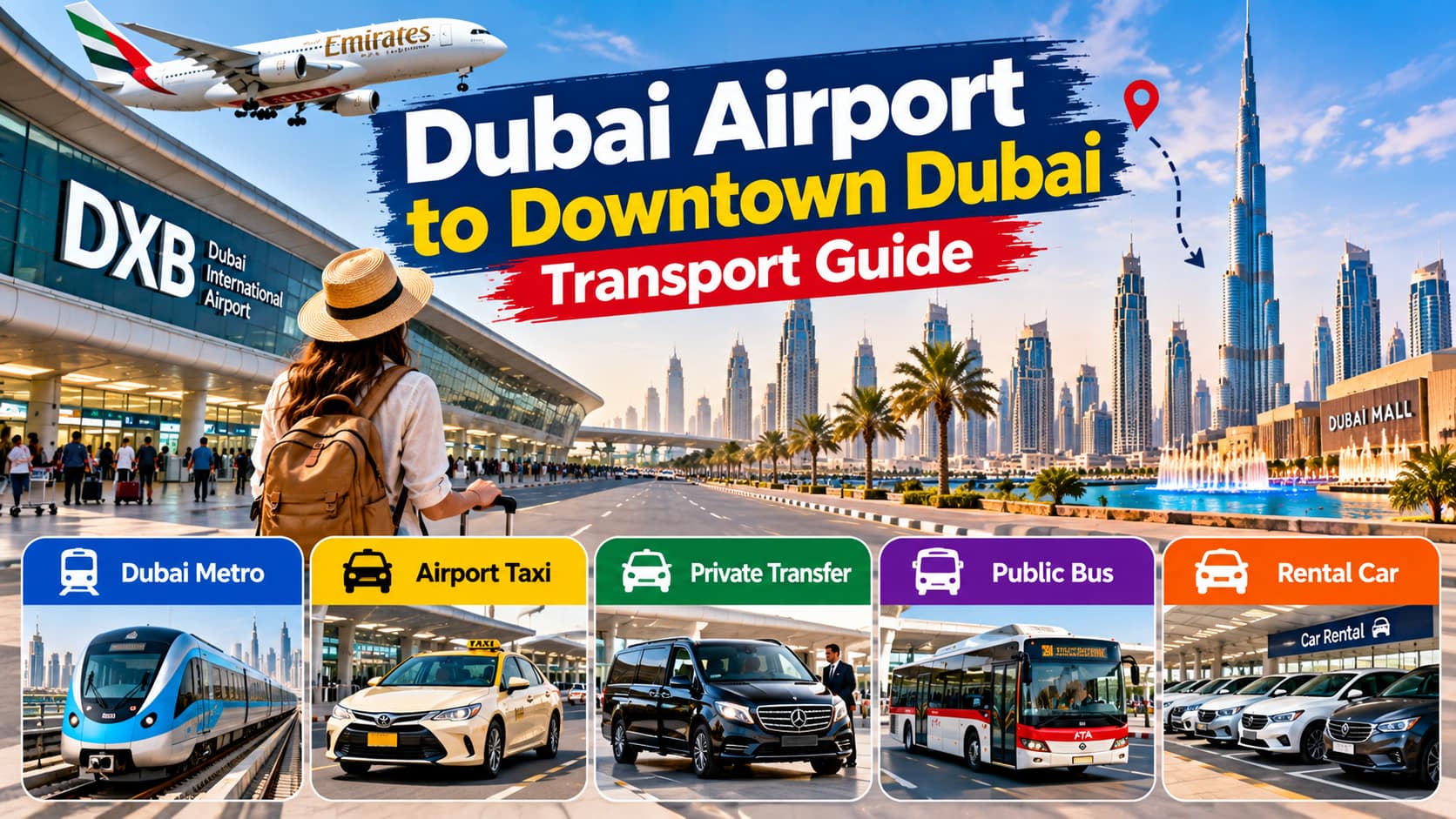
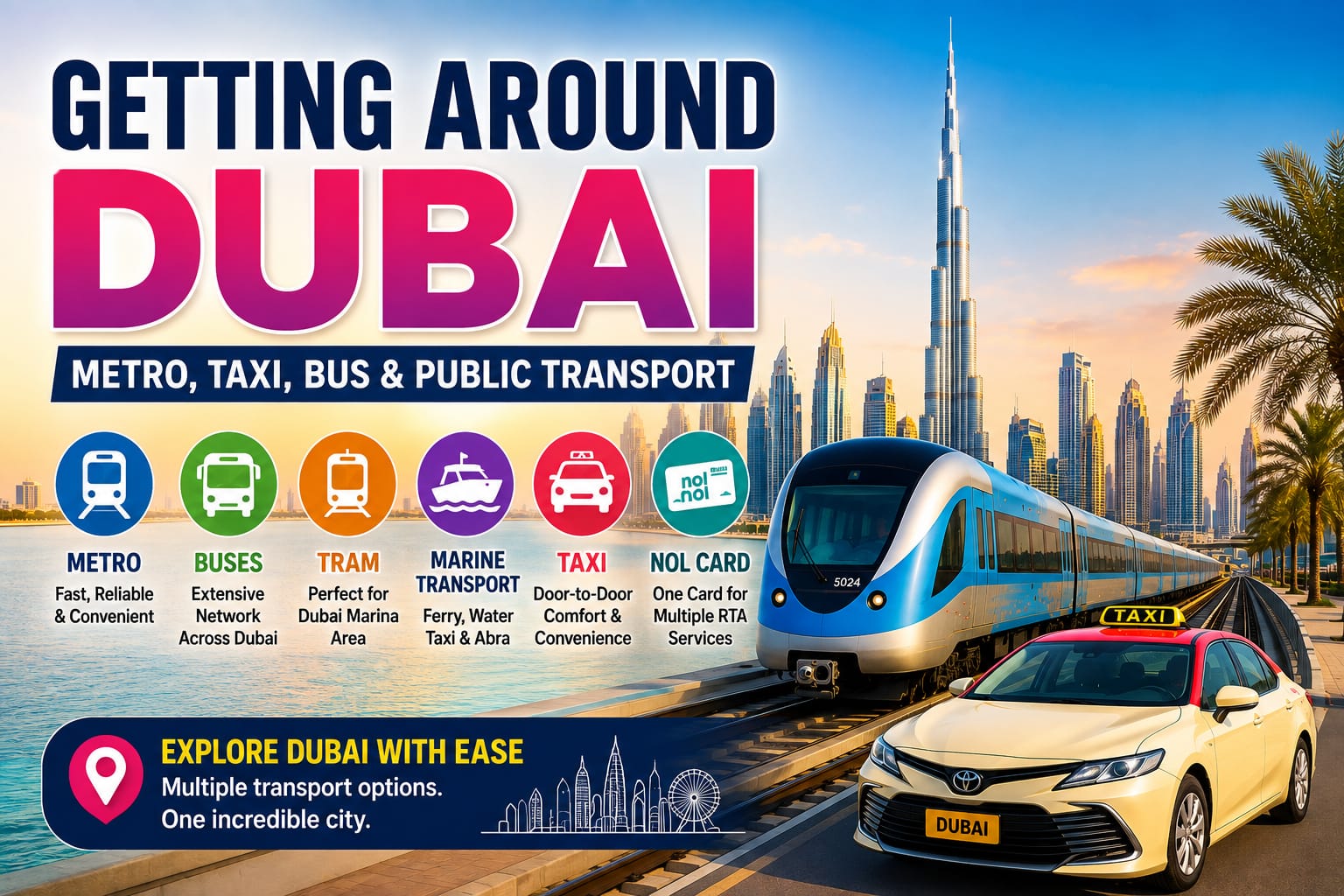
Dubai Public Transport Guide helps tourists understand how to travel around the city using the Dubai Metro, public buses, trams, taxis and water transport. Whether you are arriving at Dubai International Airport, visiting Downtown Dubai or exploring Dubai Marina, knowing how the transport system works can help you save time and manage your travel expenses.
Dubai has a modern public transport network managed mainly by the Roads and Transport Authority (RTA). Visitors can use a rechargeable Nol card to pay for most public transport services, making it easier to move between popular attractions, hotels, shopping malls and business districts.
Dubai Public Transport: An Overview
Dubai offers several transport options for tourists, residents and business travellers. The most suitable option depends on your destination, budget, travel time and convenience.
The main public transport services in Dubai include:
- Dubai Metro: A driverless rail network connecting major areas, including the airport, Downtown Dubai and Dubai Marina.
- Dubai Public Buses: Air-conditioned buses connecting Metro stations, residential communities and destinations across the city.
- Dubai Tram: A convenient transport option for Dubai Marina, Jumeirah Beach Residence (JBR) and nearby areas.
- Dubai Taxis: Metered taxis for direct journeys, airport transfers and destinations that are not easily accessible by rail.
- Dubai Water Transport: Abras, ferries and water taxis operating on selected routes across Dubai Creek and coastal areas.
Most RTA public transport services accept the Nol card, allowing passengers to use one payment card across different modes of transport.
Dubai Metro Guide: Red Line, Green Line and Stations
The Dubai Metro is one of the most convenient and widely used public transport options in the city. It is a fully automated, driverless rail system connecting important residential, commercial and tourist destinations.
The Metro operates on two main lines: the Red Line and the Green Line.
Dubai Metro Red Line
The Red Line is particularly useful for tourists because it connects Dubai International Airport with several major destinations. It serves areas such as Deira, Bur Dubai, Downtown Dubai, Business Bay and Dubai Marina, with connections towards Expo City Dubai.
Some popular locations accessible from or near the Red Line include:
- Dubai International Airport, Terminals 1 and 3
- Union and BurJuman interchange areas
- Burj Khalifa and Dubai Mall
- Business Bay
- Mall of the Emirates
- Dubai Marina
- Expo City Dubai
The nearest Metro station may still require a walk, connecting bus or taxi ride to reach the final destination.
Dubai Hotel Booking Guide: Choosing the Right Accommodation
Dubai Travel Insurance: Coverage & Benefits
Dubai Travel Budget: Accommodation, Transport & Daily Costs
Dubai Metro Green Line
The Green Line serves several historic and traditional neighbourhoods, making it useful for visitors interested in Old Dubai. It connects areas such as Al Fahidi, Al Ghubaiba, Baniyas Square and other locations around Dubai Creek.
Tourists can use the Green Line to explore traditional markets, heritage areas, museums and older parts of the city. Passengers can transfer between the Red and Green Lines at designated interchange stations.
Dubai Metro Timings
Dubai Metro operates throughout the week, but operating hours can vary by day, station, public holiday and special event.
Trains generally run from early morning until late at night. Visitors should check the latest RTA timetable before travelling, particularly when planning airport transfers or late-night journeys.
Train frequency also changes depending on demand, with more frequent services during busy periods.
Dubai Travel Safety, Local Laws and Essential Tips
Dubai Airport to Downtown Dubai: Transport Guide
Dubai to Abu Dhabi & Sharjah: Transport Guide
Dubai Metro Fares
Dubai Metro fares are based on the number of transport zones crossed during a journey. Standard adult fares using a Silver Nol card are:
| Journey | Fare |
|---|---|
| Within one zone | AED 3 |
| Across two adjacent zones | AED 5 |
| Across more than two zones | AED 7.50 |
Gold Class fares are generally double the standard Silver fare. The actual fare is calculated automatically when passengers tap their Nol card at the entry and exit gates.
Nol Card Dubai: Types, Prices and How to Use
The Nol card is a rechargeable smart card used to pay for Dubai Metro, public buses, Dubai Tram and selected marine transport services. It can also be used for certain other RTA services.
For most visitors, purchasing a Nol card is a practical way to pay for public transport without buying an individual ticket for every journey.
Types of Nol Cards
Silver Nol Card
The Silver Nol card is a suitable option for most tourists. It provides access to standard public transport fares and can be used across the main RTA transport network.
The standard card price is AED 25, which includes AED 19 in stored credit. Passengers can recharge the card when the balance becomes low.
Gold Nol Card
The Gold Nol card allows passengers to use Gold Class cabins on the Metro and Tram, where available. These cabins offer a different travel experience, and fares are generally twice the standard Silver card fare.
The standard card price is AED 25, including AED 19 in stored credit.
Personal Nol Card
The Personal Nol card is a registered card designed for eligible users who may need concessionary fares or additional account protection. It is more commonly used by residents and frequent travellers than short-term tourists.
Red Nol Ticket
The Red Nol Ticket is a paper-based ticket designed for occasional travel. It can be purchased at Metro stations and is useful for visitors who only plan to make a limited number of journeys. It has specific usage conditions and is less flexible than a rechargeable Silver card.
Where to Buy a Nol Card in Dubai
Tourists can purchase a Nol card from:
- Dubai Metro station ticket offices
- Metro station ticket vending machines
- RTA customer service centres
- Authorised sales agents
- Supported online RTA services
Visitors arriving at Dubai International Airport can purchase a suitable ticket or Nol card at the airport Metro station, where available.
How to Use a Nol Card
Using a Nol card is simple:
- Purchase a Nol card and ensure it has sufficient balance.
- Tap the card on the reader when entering the Metro station or boarding a bus.
- Wait for the confirmation signal before proceeding.
- Tap the same card again when exiting the Metro or completing a journey where check-out is required.
- The system calculates and deducts the applicable fare.
Passengers should keep the same card throughout a journey and make sure they complete the required check-in and check-out steps.
A minimum balance is required to travel. Check the current RTA requirements before starting your journey.
Nol Card Recharge and Balance
Nol cards can be recharged at Metro station ticket offices, vending machines and supported digital services. Travellers should check their remaining balance before boarding, especially when planning several journeys in one day.
Some transport journeys allow transfers between Metro and buses within the permitted transfer period, subject to RTA rules. Using the card correctly helps ensure the fare is calculated as intended.
Dubai Public Bus Guide: Routes, Fares and Services
Dubai’s public bus network connects areas that are not directly served by the Metro. Air-conditioned buses operate across residential communities, business districts, shopping areas and transport hubs.
Many bus routes connect with Metro stations, making it easier to travel to destinations that require more than one mode of transport.
Dubai Bus Fares
Public bus fares are generally calculated according to the number of zones crossed when using a Silver Nol card.
| Journey | Fare |
|---|---|
| Within one zone | AED 3 |
| Across two adjacent zones | AED 5 |
| Across more than two zones | AED 7.50 |
The final fare depends on the route and applicable transfer rules. Passengers should tap their Nol card when boarding and follow the required check-out procedure.
When to Use Dubai Buses
Buses can be useful for reaching residential areas, beaches, attractions and neighbourhoods located away from Metro stations. They are also a practical option for connecting from a Metro station to a nearby destination.
Before travelling, check the route, bus stop and expected arrival time using the RTA journey planner or supported transport applications. Journey times can vary depending on traffic conditions.
Dubai Tram Guide: Routes and Fares
The Dubai Tram is a convenient transport option for people visiting or staying in Dubai Marina, Jumeirah Beach Residence and nearby areas. It connects with selected Metro stations and provides access to waterfront destinations, hotels, residential communities and leisure areas.
The tram is particularly useful for short journeys within the Marina and JBR districts, where visitors may prefer not to walk long distances.
Passengers can use a Nol card to pay for Dubai Tram journeys. Fares follow the applicable RTA fare rules, so visitors should check their journey details before travelling.
Dubai Taxi Guide: Booking, Fares and Payment
Dubai taxis provide direct transport across the city and are useful for destinations that are not conveniently connected by the Metro or bus network. Taxis can be found at designated stands, hotels, shopping malls, airports and other major locations.
Dubai taxis generally operate using a meter, and the final fare depends on the distance travelled, journey time, pickup method and applicable charges.
Dubai Taxi Fares
Taxi fares may vary according to the service and booking method. A minimum fare commonly starts around AED 12 for a roadside pickup, while electronically booked taxis may have a different starting fare. Additional charges can apply to airport pickups, toll roads and other applicable services.
Since tariffs can change, visitors should confirm the current fare details through official RTA information or the booking application before travelling.
How to Book a Taxi in Dubai
Visitors can take a taxi from an official taxi stand or arrange a ride using supported booking services, including Hala through Careem and other available ride-hailing applications.
When taking a taxi:
- Check that the meter is running for a metered journey.
- Confirm the destination with the driver.
- Check whether toll or other additional charges may apply.
- Use the available payment methods accepted by the taxi.
Taxis can be especially convenient for families, travellers with luggage and visitors travelling to places far from public transport stations.
Dubai Water Transport: Abra, Ferry and Water Taxi
Dubai offers several water transport services that allow passengers to travel along selected waterways and coastal routes. Some services are practical transport options, while others are popular with visitors who want to experience Dubai from the water.
Dubai Abra
Traditional abras operate on selected routes across Dubai Creek, connecting parts of Bur Dubai and Deira. They offer a short crossing and provide a traditional way to experience the historic waterfront.
Some traditional abra routes have fares starting from around AED 1, depending on the service. Check the route and payment arrangements before boarding.
Dubai Ferry
Dubai Ferry operates on selected routes connecting certain waterfront destinations. It can be an alternative to road transport on supported routes and also provides views of Dubai’s coastline.
Routes, schedules and fares vary, so passengers should confirm current service details before planning a journey.
Dubai Water Taxi
Dubai Water Taxi services operate on selected routes and provide point-to-point travel along parts of the city’s waterways. They are generally more expensive than standard Metro and bus journeys and may be better suited to specific travel needs or experiences.
Dubai Public Transport Fares: A Comparison
The cost of travelling around Dubai depends on the transport mode, distance, zones crossed and applicable fare rules.
| Transport option | Approximate cost |
|---|---|
| Metro with Silver Nol | AED 3–7.50 |
| Metro Gold Class | AED 6–15 |
| Public bus with Silver Nol | AED 3–7.50 |
| Dubai Tram | Applicable Nol zone fare |
| RTA taxi | Metered fare; minimum commonly around AED 12 for roadside pickup |
| Traditional abra | Some routes start at AED 1 |
| Dubai Ferry and Water Taxi | Varies by route and service |
These are general guide prices and may change. Taxi fares and marine transport costs are not directly comparable with fixed public transport fares because they depend on the service and journey.
Best Public Transport Options for Tourists in Dubai
Choosing the right transport option can make travelling around Dubai easier and more affordable.
The Dubai Metro is a strong option for travelling between major areas, particularly when your destination is close to a station. It can be useful for airport connections, shopping districts and popular tourist locations.
Public buses are useful for destinations beyond the Metro network and for connecting neighbourhoods with rail stations.
The Dubai Tram is convenient for short journeys around Dubai Marina and JBR.
Taxis are suitable for direct journeys, travelling with luggage, or reaching destinations that require several public transport connections.
Water transport can be useful on selected routes and offers a different way to explore Dubai Creek and the waterfront.
Many visitors use a combination of the Metro, buses and taxis to balance convenience and travel costs.
Tips to Save Money on Dubai Public Transport
Planning your journeys can help you reduce transport expenses during your stay.
- Use a Silver Nol card for standard public transport fares.
- Consider staying near a Metro station if you expect to travel frequently.
- Use buses to reach destinations that are not close to Metro stations.
- Check whether a transfer is covered by the applicable RTA transfer rules.
- Plan your route in advance to avoid unnecessary travel between stations.
- Keep sufficient credit on your Nol card to prevent delays.
- Compare the estimated taxi fare with public transport options for longer journeys.
- Check whether a travel pass is suitable for your length of stay and planned travel zones.
Visitors who expect to use public transport frequently may benefit from an eligible travel pass. Pass availability, price and conditions depend on the card type, duration and zones selected.
Dubai Public Transport Rules and Travel Tips
Dubai’s public transport system has rules intended to maintain passenger safety, comfort and order. Travellers should follow the instructions displayed at stations, on vehicles and at transport stops.
Passengers should use their own valid ticket or Nol card, follow the designated cabin rules and avoid prohibited activities. Eating, drinking or behaving inappropriately in restricted areas can result in penalties.
Women and children’s cabins are marked on Metro trains, and passengers should follow the displayed instructions. Priority seating and accessibility facilities are available for eligible passengers.
Travellers should also keep their personal belongings secure, allow passengers to exit before boarding and follow announcements during service disruptions.
Conclusion
Dubai’s public transport network offers visitors several ways to explore the city, from the Metro and public buses to taxis, trams and water transport. The Metro is convenient for many major destinations, while buses and trams provide additional connections across different neighbourhoods. Taxis are useful for direct journeys, and water transport offers access to selected waterfront routes.
For most tourists, a Silver Nol card is a practical way to pay for everyday public transport. Understanding Dubai Metro routes, Nol card fares, bus services and taxi options can help visitors plan journeys more efficiently, manage travel costs and enjoy a smoother experience while exploring Dubai.