Emirati arts, music and poetry are an important part of the cultural heritage of the United Arab Emirates. They reflect the country’s desert traditions, maritime history, family life, celebrations and strong connection with Arabic language and storytelling.
From Nabati poetry and traditional songs to Al-Ayyala, Al-Razfa, handicrafts and Arabic calligraphy, Emirati artistic traditions have been passed between generations while continuing to evolve in modern UAE society.
What Are the Traditional Arts of the UAE?
Traditional Emirati arts include performing arts, poetry, music, crafts, weaving, calligraphy and other forms of cultural expression.
Many developed from everyday life in the Emirates. Desert communities, pearl-diving and maritime traditions, tribal gatherings and celebrations all influenced the artistic forms that became part of Emirati heritage.
Traditional arts were not simply entertainment. They were also ways of preserving stories, values, identity and collective memory.
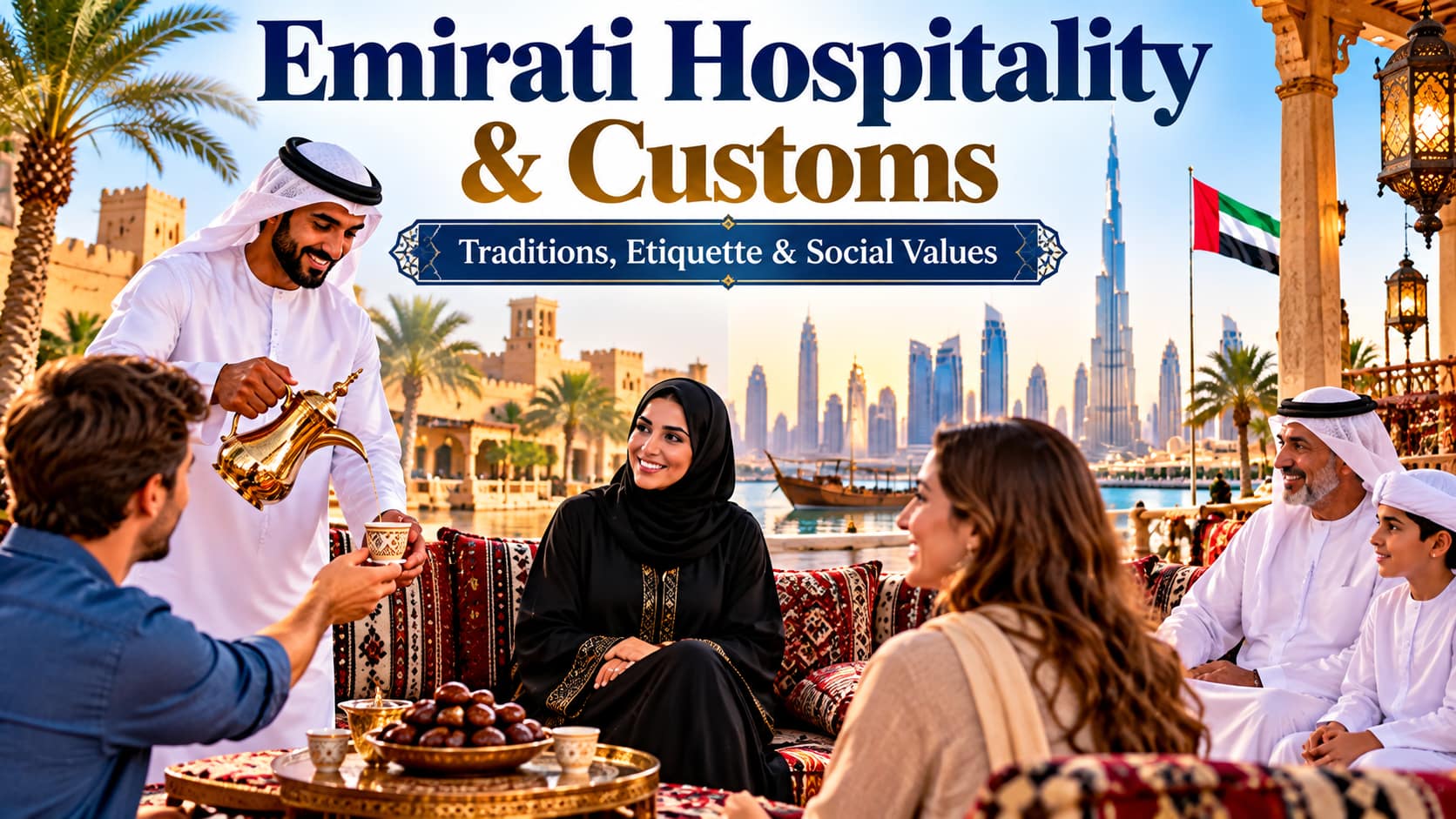
Emirati Hospitality & Customs: Traditions, Etiquette & Social Values
Emirati Wedding Traditions: Customs, Ceremonies & Culture
Why Is Poetry Important in Emirati Culture?
Poetry has a particularly important place in Emirati culture.
Nabati poetry, sometimes described as Bedouin or “people’s poetry,” developed as an important form of popular Arabic poetry in the Arabian Peninsula. It has traditionally been used to express subjects such as courage, honour, wisdom, love, pride and everyday experiences.
For generations, poetry was often shared orally. Poets could use verses to tell stories, express emotions, preserve memories and comment on society.
Today, poetry remains visible in cultural programmes, literary events, festivals and public performances across the UAE.
Traditional Emirati Dishes: Famous Foods & UAE Cuisine
Traditional Emirati Clothing: Dress, Meaning & Cultural Identity
What Is Nabati Poetry?
Nabati poetry is one of the best-known forms of traditional poetry associated with the Gulf and Emirati heritage.
Unlike formal Classical Arabic poetry, Nabati poetry developed through spoken vernacular traditions and became closely connected with Bedouin and Gulf communities.
Its subjects can range from personal experiences and relationships to wisdom, heritage, courage and social values.
Nabati poetry also continues to influence modern Emirati cultural life, with poets and cultural institutions supporting its preservation and development.
What Is Al-Ayyala?
Al-Ayyala is one of the most recognisable traditional performing arts of the UAE.
The performance generally features rows of men and boys facing one another while moving rhythmically with thin bamboo canes. Drums provide the beat, while participants perform coordinated movements and chants connected with poetry.
Al-Ayyala is associated with important occasions including weddings, festivals and national celebrations.
It represents more than a dance. The performance brings together poetry, rhythm, movement and group participation, making it an important expression of Emirati cultural identity.
What Is Al-Razfa?
Al-Razfa is another traditional Emirati performing art that combines poetry, rhythm and coordinated movement.
It has deep roots in UAE culture and has traditionally been associated with celebrations, weddings and welcoming important guests.
Like other Emirati performing arts, Al-Razfa connects poetry and music with community participation and cultural expression.
What Role Does Music Play in Emirati Culture?
Traditional Emirati music developed around different aspects of life, including weddings, celebrations, social gatherings and maritime activities.
Music was also closely connected with poetry. Forms such as Al Shila and Al Wana combine musical expression with verses, showing how closely poetry and music have historically been connected in Emirati culture.
Traditional instruments include drums and string instruments such as the oud and rababa.
Music also played an important role in the historical maritime life of the UAE. Pearl-diving communities used work songs and rhythmic chants during long periods at sea, helping workers maintain coordination and rhythm.
What Are Emirati Traditional Songs?
Traditional Emirati songs include forms connected with work, celebrations, poetry and community gatherings.
Maritime songs are particularly significant because they preserve memories of the UAE’s pearling heritage. Crews used songs to maintain rhythm while rowing, working with sails and carrying out other tasks at sea.
Other forms of traditional singing are connected with weddings, festivals and cultural celebrations.
These musical traditions continue to appear in heritage performances and cultural programmes throughout the UAE.
What Traditional Crafts Are Part of Emirati Art?
Emirati artistic heritage also includes traditional crafts.
Al Sadu, a traditional weaving practice, is one of the best-known examples. It historically involved weaving patterns and textiles associated with Bedouin communities and has become an important symbol of UAE heritage.
Other traditional crafts include pottery, embroidery, textile work and decorative arts.
These crafts demonstrate how art was traditionally connected with practical everyday life rather than being separated from it.
What Is the Role of Arabic Calligraphy in Emirati Art?
Arabic calligraphy is another important form of artistic expression in the UAE.
Poetry and calligraphy often come together, with verses transformed into visual artworks. This creates a connection between the written Arabic language and traditional artistic expression.
Modern cultural programmes in the UAE continue to support Arabic calligraphy, poetry and other creative disciplines as part of the country’s wider cultural heritage.
How Are Emirati Arts Preserved Today?
The UAE has developed cultural institutions, festivals, museums, literary programmes and heritage events that help preserve traditional arts.
Traditional music and poetry are increasingly presented alongside contemporary cultural programmes, allowing younger generations and international visitors to experience them in new settings.
Digital platforms are also being used to document and share traditional Emirati music and poetry with wider audiences.
This approach helps keep heritage connected to modern life rather than treating traditional culture as something that exists only in the past.
Emirati Arts, Music and Poetry in Modern UAE
Emirati culture today combines heritage with contemporary creativity.
Traditional poetry continues alongside modern literature. Heritage performances appear at major celebrations and festivals, while Emirati musicians and artists participate in contemporary cultural programmes.
The UAE’s modern arts scene also includes painting, theatre, film, literature and other creative forms alongside traditional music, poetry and crafts.
This combination allows Emirati artists to preserve cultural identity while exploring new forms of expression.
Why Do Emirati Arts Matter to UAE Identity?
Emirati arts, music and poetry preserve stories that connect modern UAE society with earlier generations.
They reflect the country’s desert environment, maritime history, family traditions, social values and relationship with the Arabic language.
For visitors, experiencing these traditions provides a deeper understanding of the UAE beyond its skyscrapers, shopping malls and modern attractions.
For Emiratis, they remain an important part of cultural identity and national heritage.
Emirati Arts, Music & Poetry: A Living Heritage
Emirati arts, music and poetry are not simply historical traditions displayed in museums. They remain part of cultural life across the UAE.
From Nabati poetry and traditional songs to Al-Ayyala, Al-Razfa, weaving and calligraphy, these forms continue to connect generations with the heritage of the Emirates.
As the UAE continues to develop as a modern global country, its traditional arts provide an important link between the nation’s past, present and future.