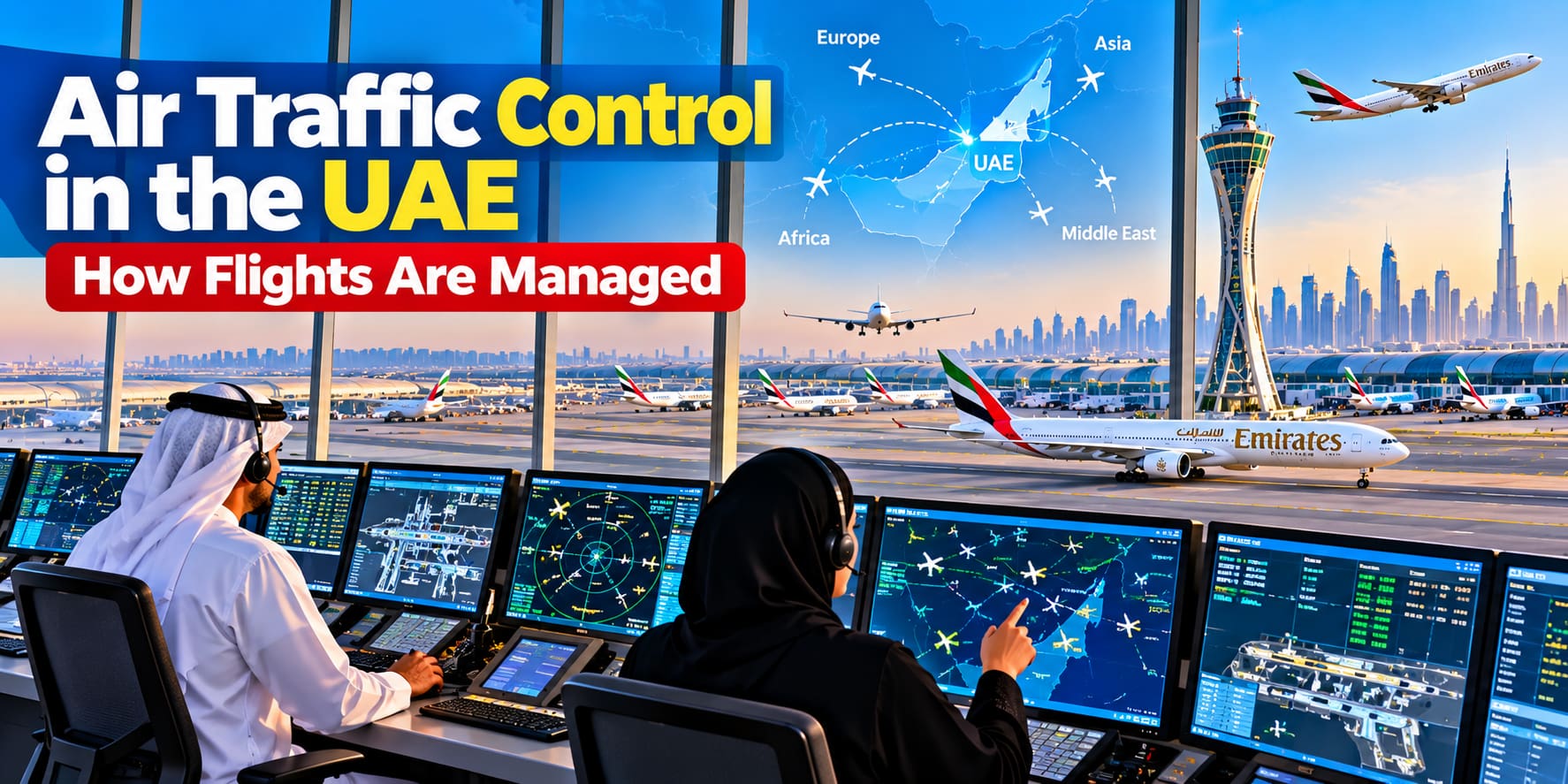
Air Traffic Control in the UAE plays a vital role in keeping thousands of aircraft movements organised and safe across the country’s busy airspace. Every aircraft taking off, landing or flying over the UAE must operate within a carefully coordinated system that connects airports, runways, control centres and aircraft crews.
With major international airports in Dubai and Abu Dhabi and extensive connections between Asia, Europe, Africa and the Middle East, UAE airspace can be extremely busy. Managing that traffic requires much more than simply directing aircraft toward runways.
Air traffic controllers continuously coordinate aircraft positions, flight paths, altitudes, departures and arrivals while maintaining the required separation between aircraft.
What Is Air Traffic Control?
Air Traffic Control, commonly called ATC, is the system used to manage aircraft movements in controlled airspace and around airports.
The basic objective is simple:
Keep aircraft safely separated while helping them move efficiently through the airspace.
Controllers communicate with pilots and provide instructions or clearances relating to areas such as:
- Take-off and departure
- Climb and descent
- Flight routes
- Altitude
- Speed
- Changes in flight path
- Arrival procedures
- Landing
- Ground movement at airports
Air traffic control does not mean that one controller follows an aircraft from take-off until landing. Different controllers and control sectors become responsible for an aircraft as it moves through different parts of its journey.
Who Manages Air Traffic in the UAE?
The UAE’s aviation system involves several organisations with different responsibilities.
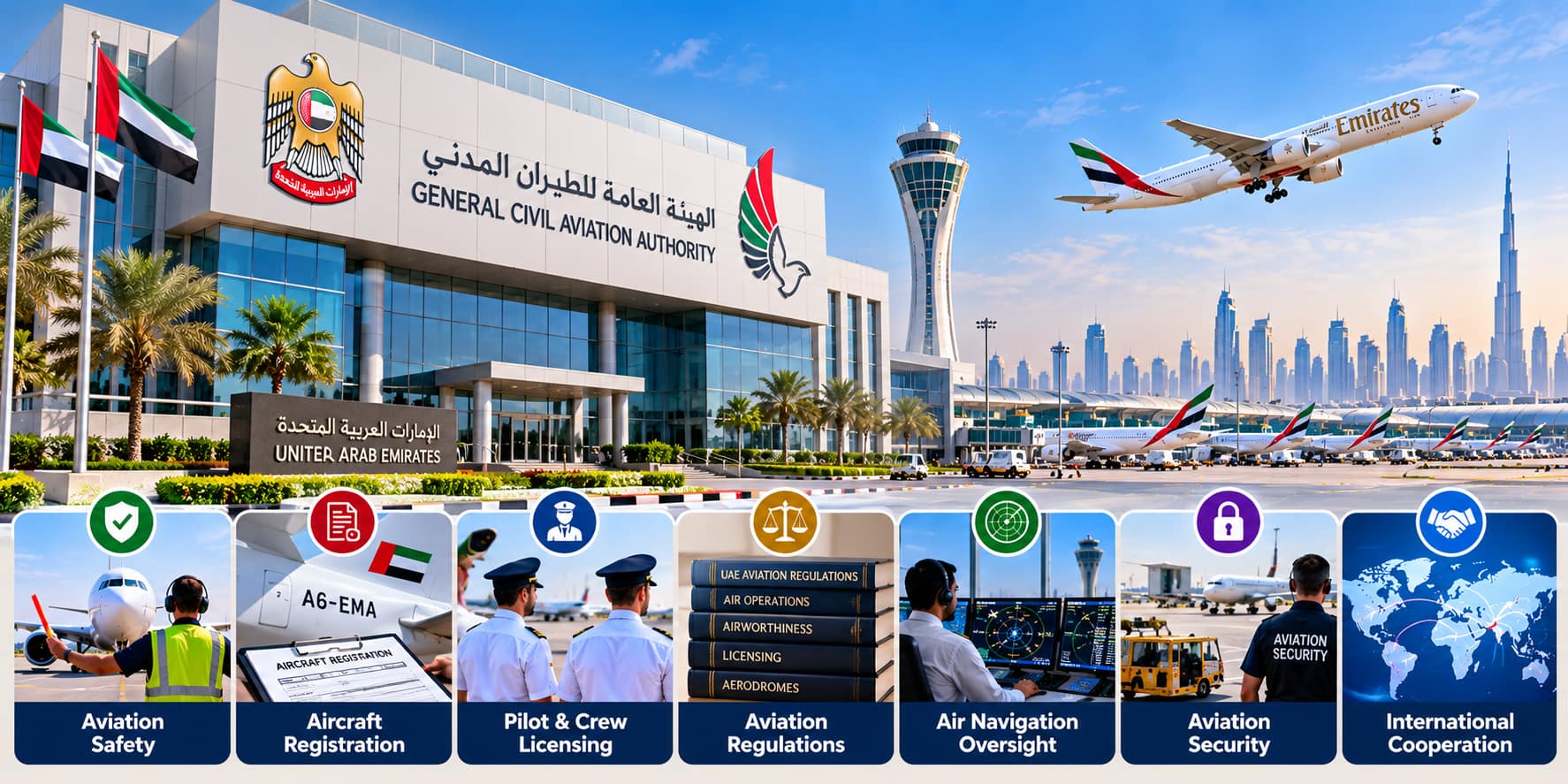
The General Civil Aviation Authority (GCAA) is the country’s federal civil aviation authority and has an important role in aviation regulation, safety oversight and the wider management of the UAE’s aviation system.
Air navigation service providers and airport-based air traffic control operations are responsible for the practical management of aircraft movements within their designated areas.
This means aviation management in the UAE is not handled by one single control tower. Different facilities and control units work together as aircraft move between airports and through different sections of UAE airspace.
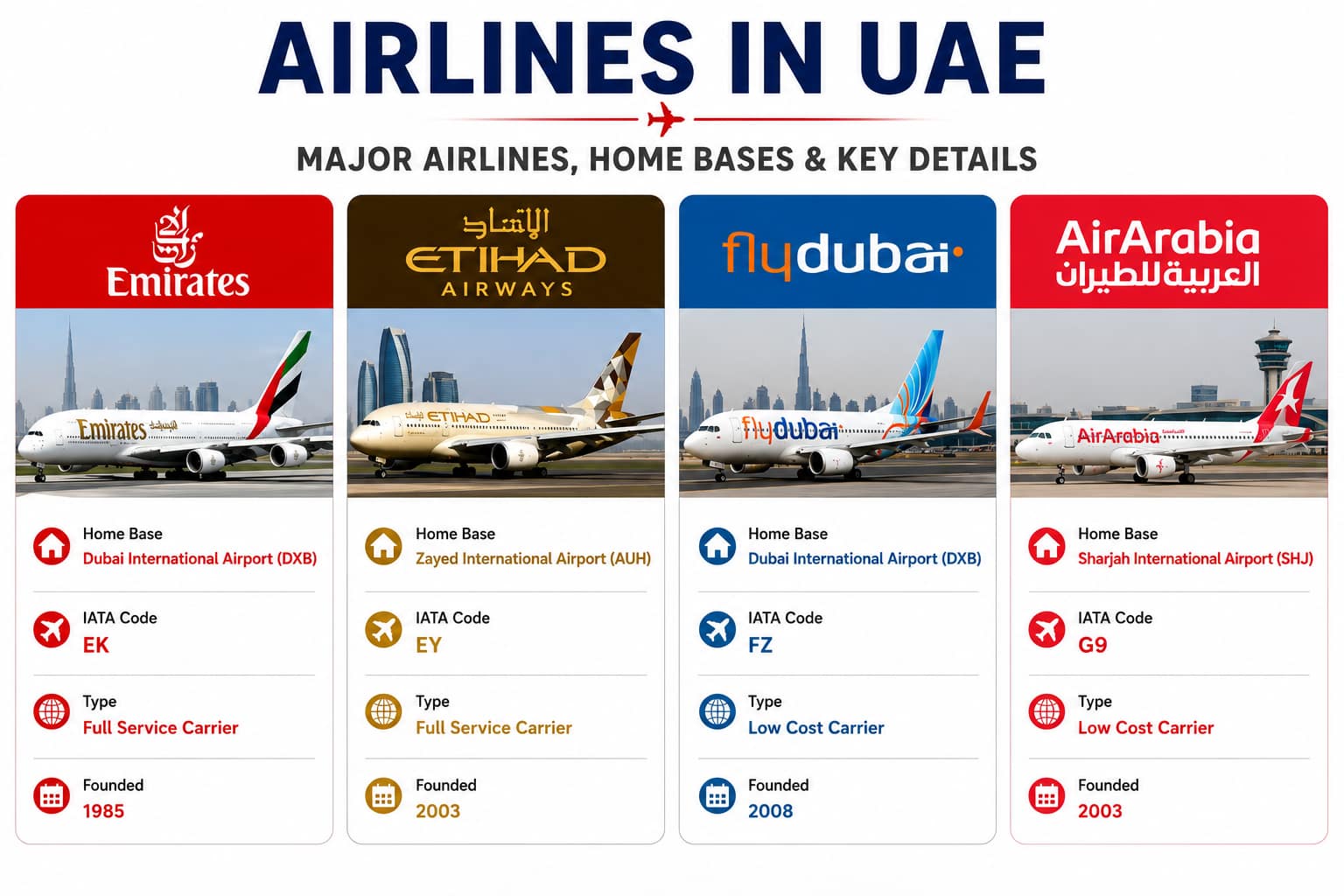
Airlines in UAE: Major Airlines, Home Bases & Key Details
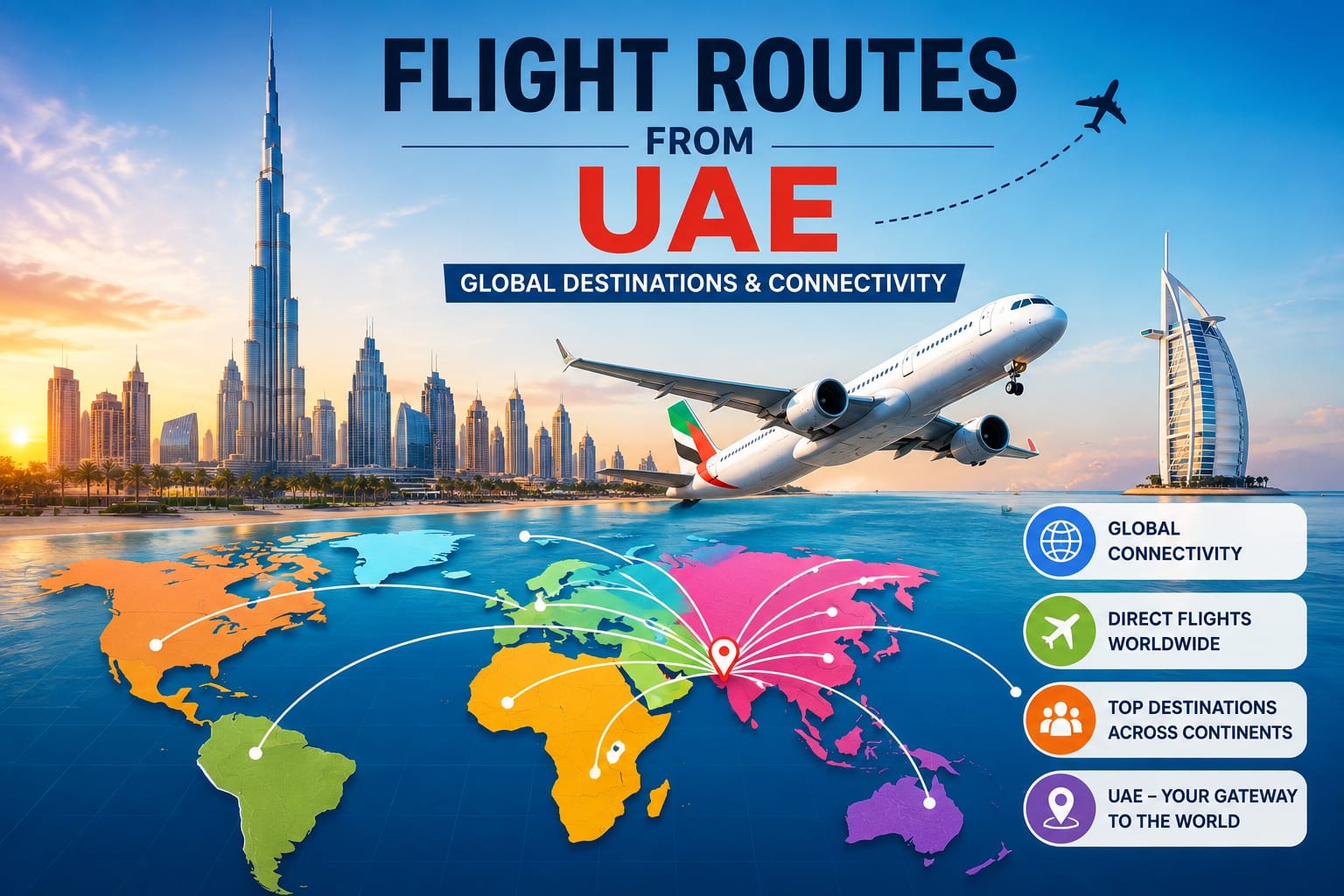
Flight Routes from UAE: Global Destinations & International Connectivity
How Does UAE Airspace Work?
UAE airspace is divided into controlled areas and sectors so that aircraft can be managed according to their location and altitude.
Instead of having one controller responsible for every aircraft across the entire country, responsibility is divided between different control positions.
This allows controllers to concentrate on a manageable number of aircraft within a particular area.
An aircraft travelling from another country toward Dubai, for example, may initially be managed by an en-route control sector before being transferred to another controller as it approaches the destination airport.
The same principle applies when aircraft depart from UAE airports and climb into higher levels of controlled airspace.
UAE Civil Aviation Authority: Roles & Responsibilities
UAE Air Cargo Industry: Airports, Logistics & Global Trade
The Three Main Stages of Air Traffic Control
Although aviation operations involve many specialised control positions, the passenger journey can broadly be understood through three major stages:
1. Ground Control
Ground controllers manage aircraft and other authorised movements on airport surfaces.
Their responsibilities can include:
- Taxiways
- Aircraft movement between gates and runways
- Ground traffic coordination
- Pushback and taxi instructions
- Coordination with other airport operations
Before an aircraft reaches the runway, it must be safely guided through the airport’s ground movement system.
2. Tower Control
The airport control tower manages aircraft operating around the airport, particularly take-offs and landings.
Controllers coordinate the sequence of departing and arriving aircraft and provide clearances for runway use.
When several aircraft are approaching an airport at the same time, controllers must organise them carefully so that each aircraft can land or continue safely.
3. Area or En-Route Control
Once an aircraft climbs away from the airport, it enters a wider section of controlled airspace.
En-route controllers manage aircraft travelling between airports and across different sectors.
They monitor aircraft positions and coordinate transfers between sectors and neighbouring control areas.
This is especially important in the UAE because the country’s airspace connects major international routes.
What Happens When an Aircraft Takes Off?
The process begins before the aircraft actually leaves the runway.
The airline’s flight crew prepares the flight plan and receives the information required for the journey.
Once the aircraft is ready, it receives instructions to move from its parking position toward the runway.
The aircraft may pass through several stages of control:
Gate → Ground Control → Tower → Departure Control → En-Route Control
After take-off, the aircraft climbs according to its assigned instructions.
Controllers coordinate its route and altitude with other aircraft operating in nearby sectors.
As the aircraft moves away from the airport, responsibility gradually transfers from one controller or sector to another.
How Does a Controller Know Where Every Aircraft Is?
Modern air traffic control relies on several technologies rather than visual observation alone.
Controllers can use surveillance systems that provide information about aircraft positions and movements.
These systems can include:
- Radar
- Automatic Dependent Surveillance systems
- Aircraft identification data
- Radio communication
- Flight plans
- Navigation information
- Digital air traffic management systems
Together, these technologies give controllers a continuously updated picture of aircraft operating within their area of responsibility.
What Is Radar Used For?
Radar has historically been one of the most important tools in air traffic control.
Ground-based radar systems can detect aircraft and provide information about their position and movement.
Controllers can use this information to understand where aircraft are located relative to one another.
However, modern air traffic management does not depend exclusively on traditional radar.
Aircraft can also transmit their own position and identification information through modern surveillance technologies, allowing controllers to receive detailed information about aircraft movements.
What Is ADS-B?
ADS-B stands for Automatic Dependent Surveillance–Broadcast.
It allows suitably equipped aircraft to automatically broadcast information such as their position, altitude, speed and identification.
Ground systems can receive this information and use it as part of the wider surveillance picture.
ADS-B has become an important technology in modern aviation because it can provide accurate aircraft position information and improve situational awareness.
It works alongside other surveillance and communication systems rather than simply replacing every other system.
How Do Controllers Keep Aircraft Separated?
One of the most important responsibilities of air traffic controllers is maintaining safe separation between aircraft.
Aircraft are not allowed to fly randomly through controlled airspace.
Controllers use established procedures, routes, altitudes and separation standards to ensure that aircraft maintain appropriate distances from one another.
For example, two aircraft travelling in the same general direction may be assigned different altitudes or separated by distance and time.
When traffic becomes heavier, controllers may adjust aircraft speeds, headings or altitudes to maintain safe spacing.
How Are Departures Managed at Busy UAE Airports?
Large airports can have multiple aircraft waiting to depart while other aircraft are arriving.
The tower and departure control system therefore has to coordinate several movements simultaneously.
Controllers consider factors such as:
- Runway availability
- Aircraft position
- Departure sequence
- Arrival traffic
- Weather
- Aircraft performance
- Airspace restrictions
- Traffic in neighbouring sectors
A departing aircraft may therefore be delayed for a short period even when its passengers are already ready to leave.
The delay can be part of a larger traffic-management sequence designed to maintain safe and efficient operations.
How Are Arrivals Managed?
Arriving aircraft normally begin their approach well before reaching the airport.
As the aircraft approaches the destination, controllers gradually organise it into the appropriate arrival sequence.
Aircraft may be assigned specific headings, altitudes and speeds while being guided toward the approach path.
The process can involve:
En-route sector → Arrival control → Approach control → Tower → Runway
The exact control structure varies according to the airport and its operating procedures.
At a busy airport, several aircraft may be approaching simultaneously, making accurate sequencing essential.
What Happens During Landing?
Once an aircraft is established on its approach, the tower controller manages the final stage of the landing process.
The pilot receives the appropriate landing clearance when the runway is available and the required separation has been established.
After touchdown, the aircraft exits the runway and returns to the airport’s ground movement system.
Ground controllers then help coordinate its movement toward the assigned gate or parking position.
The same airport therefore uses different control functions for different parts of the aircraft’s journey.
How Does Air Traffic Control Work During Bad Weather?
Weather can significantly affect air traffic management.
Conditions such as thunderstorms, strong winds, reduced visibility, dust or other atmospheric conditions may require changes to normal operations.
Controllers can coordinate with pilots and other aviation units to manage these situations.
Aircraft may be given different routes, altitudes or holding instructions depending on the conditions.
During periods of poor weather, traffic may also be reduced or spaced further apart to maintain safe operations.
What Is an Aircraft Holding Pattern?
Sometimes an arriving aircraft cannot land immediately.
Instead of approaching the runway directly, it may be instructed to enter a holding pattern.
A holding pattern is a predefined flight path in which an aircraft remains within a designated area while waiting for further clearance.
Aircraft may enter holding because of:
- Heavy arrival traffic
- Weather
- Runway availability
- Temporary airport restrictions
- Other operational requirements
Although passengers may experience this as a delay, holding procedures provide controllers with another way to manage traffic safely.
How Do Controllers Communicate With Pilots?
Radio communication remains a fundamental part of air traffic control.
Pilots and controllers use standard aviation communication procedures designed to make instructions clear and reduce misunderstandings.
Controllers may issue instructions involving:
- Altitude
- Heading
- Speed
- Runway
- Taxi route
- Departure clearance
- Landing clearance
- Frequency changes
Pilots are required to read back many important instructions so that controllers can confirm the information was understood correctly.
Why Are Standard Aviation Phrases Important?
Air traffic control operates internationally, and pilots from many countries use the same aviation communication system.
Standard phraseology helps reduce confusion caused by different accents, languages or communication styles.
Instead of using casual language, controllers and pilots use established terms and formats for important instructions.
This is particularly important in a country such as the UAE, where international airlines and crews operate continuously.
What Happens When an Aircraft Leaves UAE Airspace?
An international flight does not remain under the responsibility of one UAE controller throughout its journey.
As the aircraft approaches the boundary of a particular control sector, coordination takes place with the next responsible air traffic control unit.
The aircraft is then transferred to the next controller or control centre.
This process continues as the aircraft crosses different airspaces on its international route.
The same process happens in reverse when an aircraft enters UAE airspace from another country.
How Does Air Traffic Control Handle Thousands of Flights?
The answer is a combination of planning, technology, procedures and coordination.
Before aircraft arrive, flight plans provide information about their intended routes.
During the flight, surveillance systems provide information about their actual positions.
Controllers then manage the aircraft according to traffic conditions and established procedures.
When traffic increases, controllers can use techniques such as speed control, altitude changes, route adjustments and sequencing.
This allows large numbers of aircraft to use the same airspace without simply sending every aircraft along an independent route.
Air Traffic Control and Dubai’s Busy Aviation Network
Dubai’s position as a major international aviation centre makes efficient air traffic management particularly important.
Aircraft arriving at and departing from Dubai operate alongside flights travelling through the wider region.
This creates a complex network in which airport operations and wider airspace management must remain closely coordinated.
The challenge is not simply getting aircraft into Dubai or out of Dubai. It is managing their movements while maintaining safe separation from other traffic using nearby routes and airports.
The Human Role in Modern Air Traffic Control
Although modern ATC uses advanced technology, controllers remain central to the system.
Technology provides information, but trained controllers interpret that information, make decisions and coordinate aircraft movements.
Air traffic controllers require specialised training and must follow detailed operational procedures.
Their work also involves managing unexpected situations, such as weather changes, aircraft technical problems, communication issues or sudden changes in traffic flow.
This combination of technology and human decision-making is one of the foundations of aviation safety.
What Happens During an Emergency?
Air traffic control also plays an important role when an aircraft experiences an emergency.
Depending on the situation, controllers can coordinate with the flight crew, airport emergency services and other aviation authorities.
They may provide priority handling, assist with routing, clear runways or coordinate other aircraft away from the affected area.
The exact response depends on the type and severity of the emergency.
The important point is that emergency procedures are planned in advance so that different organisations can coordinate quickly when required.
The Future of Air Traffic Control in the UAE
As UAE aviation continues to grow, air traffic management is also becoming more technology-driven.
Future systems are expected to make greater use of:
- Digital air traffic management
- Advanced surveillance
- Automation
- Artificial intelligence-supported decision tools
- More efficient flight planning
- Improved traffic prediction
- Real-time data sharing
The purpose of these technologies is not to remove controllers from the system.
Instead, they can provide controllers with better information and help them manage increasingly complex traffic environments.
Why Air Traffic Control Matters to UAE Aviation
Airports and aircraft receive most of the public attention, but the air traffic control system is what helps connect them safely.
Every flight depends on coordination between pilots, controllers, airports, airlines and other aviation organisations.
For the UAE, this is especially important because the country has developed a major international aviation network while operating within a geographically concentrated region with significant air traffic.
Efficient air traffic management therefore supports both safety and the smooth movement of international aviation.
Conclusion
Air Traffic Control in the UAE is a complex system that combines trained professionals, surveillance technology, communications, flight planning and carefully established procedures.
From the moment an aircraft begins taxiing to the moment it reaches its destination, different controllers and control sectors coordinate its movement through the UAE’s airports and airspace.
The system may appear invisible to passengers sitting inside an aircraft, but it is working continuously in the background.
As the UAE continues expanding its aviation network, modern air traffic management will become even more important. The future of UAE aviation will depend not only on larger airports and more aircraft, but also on the ability to manage the airspace connecting them safely and efficiently.